You Had Me At Darkling Plain
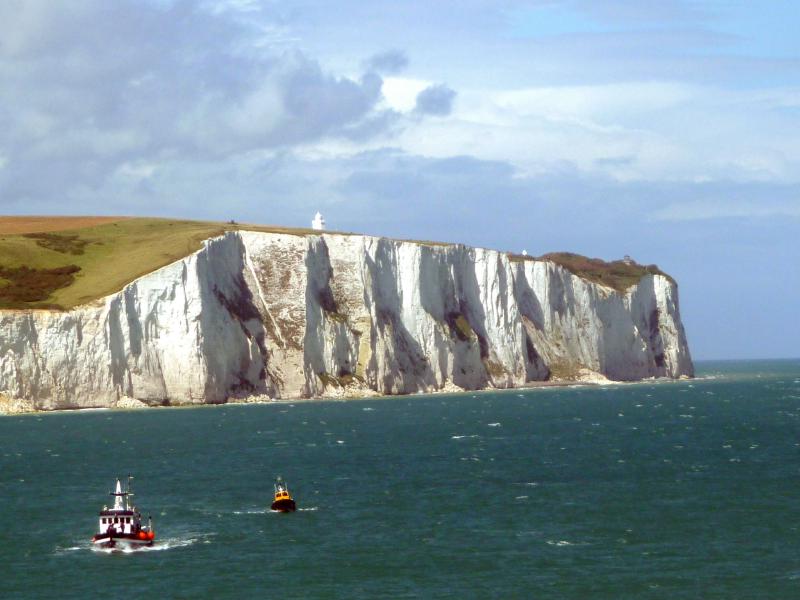
On my way in this morning I was trying to figure out what poem to share and the gloom and cold rain conspired to help me pick Dover Beach by Matthew Arnold. I first encountered this poem back in the early 80’s; there is a scene in *Fahrenheit 451 *where Guy Montag reads a fragment of this poem to his wife to try and convince her of the importance of literature. As I recall, it didn’t quite resonate with her or her friends but it did with me, and so I tried to find the poem in the school library. I asked for help from our harridan librarian, but she tried to dissuade me by telling me that it was - I’ve never forgotten this - a more advanced poem that I should wait until I was in high school to read. Looking back on it today, I’m amazed that any educator would go out of their way to try and prevent a child from learning. Of course, maybe she was trying to keep me out of the local Victorian-Poetry Reading gangs. Who knows.
Despite it being advanced I was able to find it on my own and read it. Even though I wasn’t able to understand the entire poem to the degree I do today it made an instant impression through it’s imagery and it’s haunting feel.
In High School and College Literature classes, this poem was always taught to me from a pessimistic point of view; the retreat of religion and faith in the face of the advance of science leading to a sterile and austere future where there is no joy. Yet I never took it that way. The hopeless romantic in me fixates on the lines “Ah, Love! Let us be true / To one another!”. I take this to mean that since the universe is an uncaring and cold place, the love we share with each other is the key to happiness.
Dover Beach
The sea is calm to-night. The tide is full, the moon lies fair Upon the straits; on the French coast the light Gleams and is gone; the cliffs of England stand; Glimmering and vast, out in the tranquil bay. Come to the window, sweet is the night-air! Only, from the long line of spray Where the sea meets the moon-blanched land, Listen! you hear the grating roar Of pebbles which the waves draw back, and fling, At their return, up the high strand, Begin, and cease, and then again begin, With tremulous cadence slow, and bring The eternal note of sadness in.
Sophocles long ago Heard it on the A gaean, and it brought Into his mind the turbid ebb and flow Of human misery; we Find also in the sound a thought, Hearing it by this distant northern sea.
The Sea of Faith Was once, too, at the full, and round earth’s shore Lay like the folds of a bright girdle furled. But now I only hear Its melancholy, long, withdrawing roar, Retreating, to the breath Of the night-wind, down the vast edges drear And naked shingles of the world.
Ah, love, let us be true To one another! for the world, which seems To lie before us like a land of dreams, So various, so beautiful, so new, Hath really neither joy, nor love, nor light, Nor certitude, nor peace, nor help for pain; And we are here as on a darkling plain Swept with confused alarms of struggle and flight, Where ignorant armies clash by night.
–Matthew Arnold